


- SpreadJS Overview
- Getting Started
- JavaScript Frameworks
- Best Practices
- Features
- SpreadJS Designer
- SpreadJS Designer VSCode Plugin
- Tutorials
-
SpreadJS Designer Component
- Getting Started
- Quick Start
- Theme
- Designer Interface
- JavaScript Frameworks
- Template-Based Workbook Initialization
-
Customizations
- Add a Tab
- Add Elements to a Tab
- Set Active Ribbon Tab
- Enable/Disable Ribbon Elements
- Create/Customize Page Themes
- Add Context Menu Item
- Add New Dialog
- Bind File Import Events
- Customize Status Bar
- Add a Custom Component
- Customize Designer Localization
- Customize File Menu
- Customize Format Culture Dialog
- Customize Save File Dialog
- Work in Designer Component
- Toolbar Ribbon
- API Documentation
- SpreadJS Collaboration Server
- Touch Support
- Formula Reference
- Import and Export Reference
- Events
- API Documentation
- Release Notes
Customize Format Culture Dialog
You can customize the Designer Component culture dialog in the cell format window. The Spread.Common.CultureInfo class can help in defining new culture options through properties such as locale ID, display name, and pre-defined formats (currency, accounting, date, time, special).
Initialize the designer instance.
// Initialize the designer component
var designer = new GC.Spread.Sheets.Designer.Designer("designerHost");
Get the culture info instance using the CultureInfo constructor method. It represents the custom culture class.
// Get the culture info instance
var cultureInfo = new GC.Spread.Common.CultureInfo()
Set the culture info properties to specify in the format window. Refer to Microsoft Locale ID definition to know about all the available locale IDs.
// Set new culture info for German
cultureInfo.displayName = "German (Germany)"
cultureInfo.name = function () { return "de-DE" }
cultureInfo.id = 0x407;
cultureInfo.predefinedFormats.Accounting = '_-* #,##0. [$€-407]_-;-* #,##0. [$€-407]_-;_-* "-". [$€-407]_-;_-@_-';
cultureInfo.predefinedFormats.Currency = [
    "#,##0. [$€-407]",
    "#,##0. [$€-407];[Red]#,##0. [$€-407]",
    "#,##0. [$€-407];-#,##0. [$€-407]",
    "#,##0. [$€-407];[Red]-#,##0. [$€-407]"
];
cultureInfo.predefinedFormats.Date = [
    "yyyy-mm-dd;@",
    "d.m;@",
    "d.m.yy;@",
    "dd.mm.yy;@",
    "[$-407]d. mmm.;@",
    "[$-407]d. mmm. yy;@",
    "[$-407]d. mmm yy;@",
    "[$-407]mmm. yy;@",
    "[$-407]mmmm yy;@",
    "[$-407]d. mmm yy;@",
    "[$-409]d/m/yy h:mm AM/PM;@",
    "d.m.yy h:mm;@",
    "[$-407]mmmmm;@",
    "[$-407]mmmmm yy;@",
    "d.m.yyyy;@",
    "[$-407]d. mmm. yyyy;@"
]
cultureInfo.predefinedFormats.Time = [
    "h:mm;@",
    "[$-409]h:mm AM/PM;@",
    "h:mm:ss;@",
    "[$-409]h:mm:ss AM/PM;@",
    "mm:ss.0;@",
    "[h]:mm:ss;@",
    "[$-409]d/m/yy h:mm AM/PM;@",
    "d.m.yy h:mm;@"
]
cultureInfo.predefinedFormats.Special = {
    "Postleitzahl": "00000",
    "Postleitzahl (A)": "\A-00000",
    "Postleitzahl (CH)": "C\H-00000",
    "Postleitzahl (D)": "\D-00000",
    "Postleitzahl (L)": "L-00000",
    "Versicherungsnachweis-Nr. (D)": "\[@\]",
    "Sozialversicherungsnummer (A)": "0000-00 00 00",
    "Sozialversicherungsnummer (CH)": "000\.00\.000\.000",
    "ISBN-Format (ISBN x-xxx-xxxxx-x)": "I\S\B\N #-###-#####-#",
    "ISBN-Format (ISBN x-xxxx-xxxx-x)": "I\S\B\N #-####-####-#",
    "ISBN-Format (ISBN x-xxxxx-xxx-x)": "I\S\B\N #-#####-###-#"
}
Add the new culture info object using the addCultureInfo method.
// Add new culture info
GC.Spread.Common.CultureManager.addCultureInfo(cultureInfo.name(), cultureInfo);
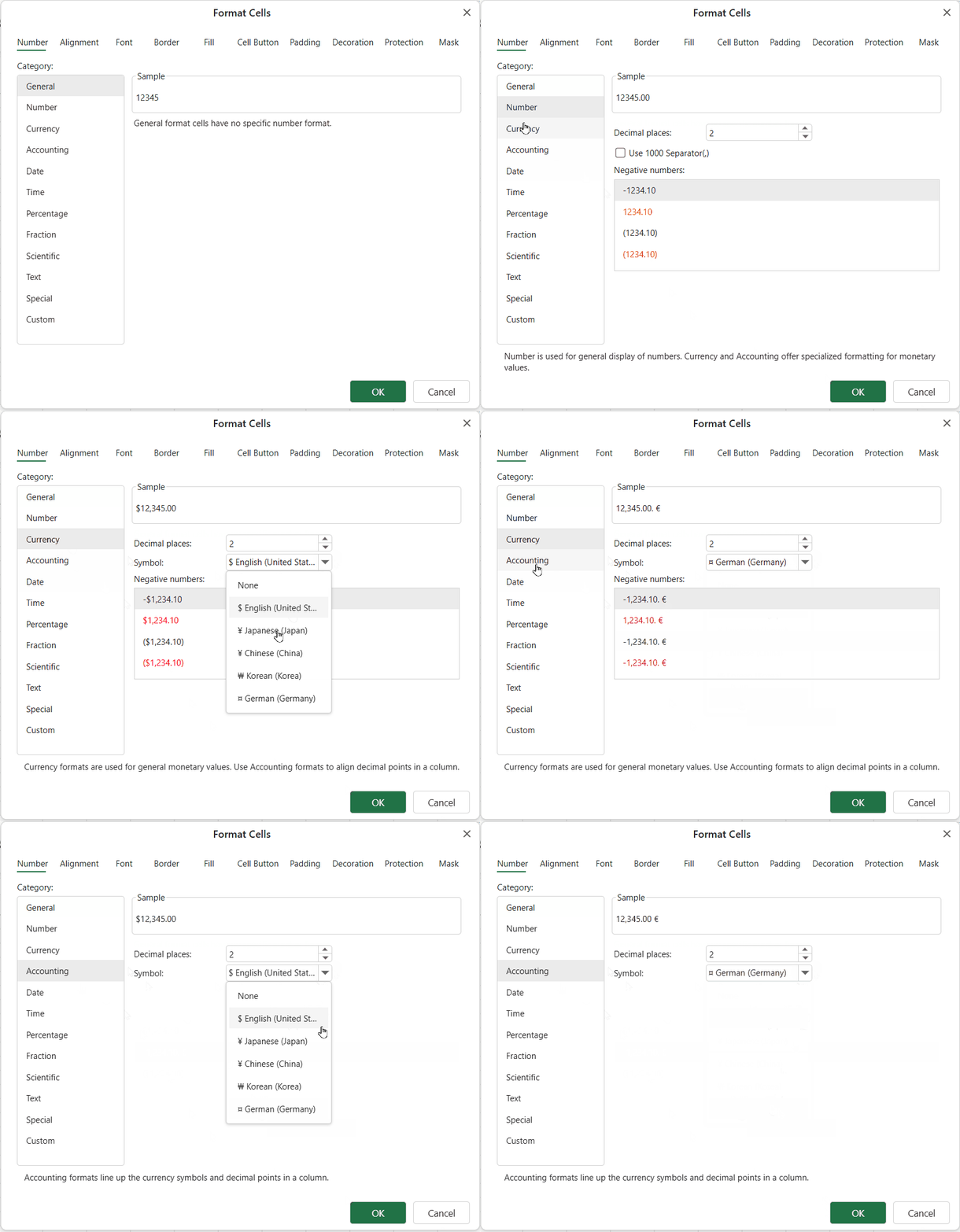
The below output will be generated:
CJK Escape Character in Custom Number Formats
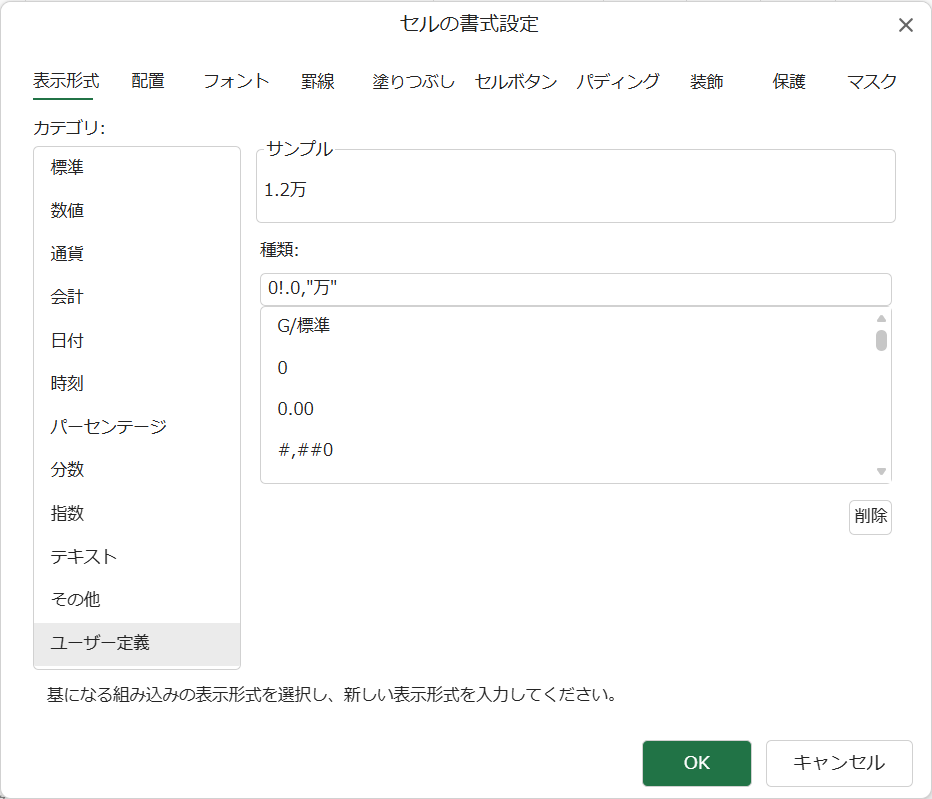
In CJK locales, the Designer Component supports the exclamation mark (!) as an escape character in the Custom number format input. This behavior provides an Excel-like localized input experience for Chinese, Japanese, and Korean environments.
For example, in a CJK locale, the following custom number format uses ! to escape the decimal point:
0!.0,"万"This format is equivalent to the following format:
0\.0,"万"Both formats can display 12000 as 1.2万.
In non-CJK locales, ! is not treated as an escape character. Use the backslash (\) escape character instead.
0\.0,"万"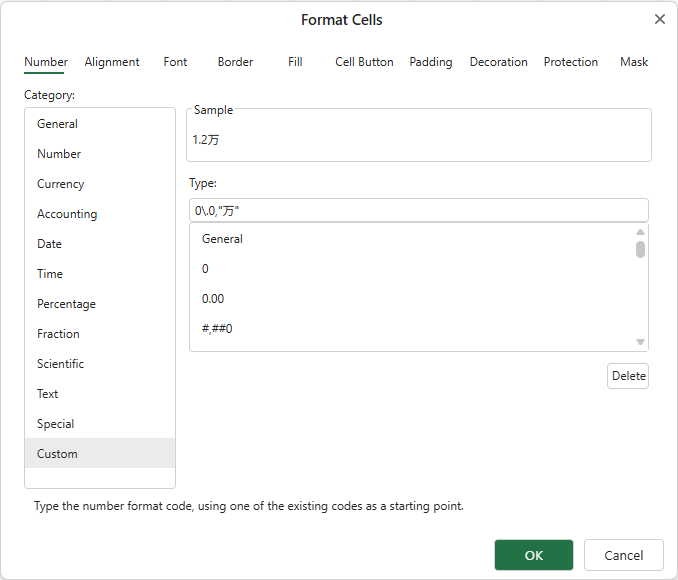
Note: The
!escape behavior applies to custom number format input in the Designer Component for CJK locales. The backslash (\) escape character is still supported for compatibility.