


- Document Solutions for Excel .NET Overview
- Key Features
- Getting Started
- Features
- Templates
-
Formula Reference
- Add-in and Automation Functions
-
Compatibility Functions
- BETADIST
- BETAINV
- BINOMDIST
- CHIDIST
- CHIINV
- CHITEST
- CONFIDENCE
- COVAR
- CRITBINOM
- EXPONDIST
- FDIST
- FINV
- FLOOR
- FTEST
- GAMMADIST
- GAMMAINV
- HYPGEOMDIST
- LOGINV
- LOGNORMDIST
- MODE
- NEGBINOMDIST
- NORM.INV
- NORMDIST
- NORMSDIST
- NORMSINV
- PERCENTILE
- PERCENTRANK
- POISSON
- QUARTILE
- RANK
- STDEV
- STDEVP
- TDIST
- TINV
- TTEST
- VAR
- VARP
- WEIBULL
- ZTEST
- Database Functions
- Date and Time Functions
- Engineering Functions
- Financial Functions
- Information Functions
- Logical Functions
- Lookup and Reference Functions
- Math and Trigonometry Functions
- Statistical Functions
- Text Functions
- Web Functions
- File Operations
- Tutorials
- Document Solutions Data Viewer
- API Reference
- Release Notes
STDEVP
This function returns the standard deviation for an entire specified population (of numeric values).
Syntax
STDEVP(number1,[number2],...)
Arguments
This function has these arguments:
Argument | Description |
|---|---|
number1 | [Required] The first number argument corresponding to a population. |
number2, ... | [Optional] Number arguments 2 to 255 corresponding to a population. You can also use a single array or a reference to an array instead of arguments separated by commas. |
Remarks
The standard deviation is a measure of how widely values are dispersed from the average value.
The standard deviation is calculated using the "biased" or "n" method.
The equation for calculating the standard deviation for a population is:
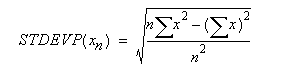
where x is the value and n is the number of values.
This function assumes that its arguments are the entire population. If your data represents a sample of the population, then compute the standard deviation using the STDEV function.
This function differs from STDEVPA, which accepts text or logical values as well as numeric values.
Examples
STDEVP(A1,B2,C3,D4,E5,F6)
STDEVP(A1:A9)
STDEVP(R1C2,R3C4,R4C5,R7C2)
STDEVP(95,89,73,87,85,76,100,96,96) gives the result 8.8079649700