- Document Solutions for Excel .NET Overview
- Key Features
- Getting Started
-
Features
-
Worksheet
- Work with Worksheets
-
Range Operations
- Access a Range
- Get Intersection, Union and Offset Range
- Access Areas in a Range
- Get Range and Range Area
- Get Special Cell Ranges
- Access Cells, Rows and Columns in a Range
- Get Address of Cell Range
- Cut or Copy Cell Ranges
- Cut or Copy Shape, Slicer, Chart and Picture
- Paste or Ignore Data in Hidden Range
- Find and Replace Data
- Get Row and Column Count
- Hide Rows and Columns
- Insert And Delete Cell Ranges
- Insert and Delete Rows and Columns
- Merge Cells
- Auto Merge Cells
- Protect Cell Range
- Set Values to a Range
- Set Custom Objects to a Range
- Set Row Height and Column Width
- Auto Fit Row Height and Column Width
- Work with Used Range
- Measure Digital Width
- Set Default Values for Cell Range
- Set Cell Background Image for Cell Range
- Ignore Errors in Cell Range
- Picture in Cell
- Customize Worksheets
- Worksheet Views
- Cell Types
- Quote Prefix
- Tags
- Rich Text
- Background Image
- Cell Checkboxes
- Workbook
- Comments
- Hyperlinks
- Sort
- Filter
- Group
- Conditional Formatting
- Data Validations
- Data Binding
- Import Data
- Digital Signatures
- Formulas
- Custom Functions
- Shapes
- Document Properties
- Styles
- Form Controls
- Barcodes
- Themes and Colors
- Chart
- Table
- Pivot Table
- Pivot Chart
- Sparkline
- Slicer
- Logging
- Defined Names
- AI Assistant
-
Worksheet
- Templates
- Formula Reference
- File Operations
- Tutorials
- Document Solutions Data Viewer
- API Reference
- Release Notes
Set Values to a Range
DsExcel allows users to specify custom values for the cell range by using the properties and methods of the IRange interface.
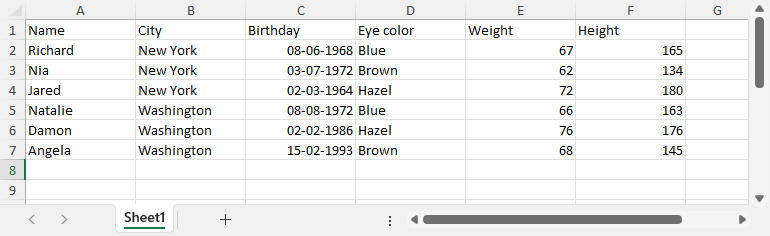
Refer to the following example code in order to set custom values to cell ranges in the worksheet.
worksheet.Range["A:F"].ColumnWidth = 15;
object[,] data = new object[,]{
       {"Name", "City", "Birthday", "Eye color", "Weight", "Height"},
       {"Richard", "New York", new DateTime(1968, 6, 8), "Blue", 67, 165},
       {"Nia", "New York", new DateTime(1972, 7, 3), "Brown", 62, 134},
       {"Jared", "New York", new DateTime(1964, 3, 2), "Hazel", 72, 180},
       {"Natalie", "Washington", new DateTime(1972, 8, 8), "Blue", 66, 163},
       {"Damon", "Washington", new DateTime(1986, 2, 2), "Hazel", 76, 176},
       {"Angela", "Washington", new DateTime(1993, 2, 15), "Brown", 68, 145}
  };

// Set two-dimension array value to range A1:F7
worksheet.Range["A1:F7"].Value = data;

// Return a two-dimension array when get range A1:B7's value.
var result = worksheet.Range["A1:B7"].Value;