# VARP
## Content
This function returns variance based on the entire population, which uses only numeric values.
## Syntax
`VARP(number1,[number2],...)`
## Arguments
This function has these arguments:
| Argument | Description |
| -------- | ----------- |
| *Number1* | [Required] The first number argument corresponding to a population. |
| *Number2,...* | [Optional] Additional numeric arguments (2 to 255) representing the population. You can also use a single array or a reference to an array instead of arguments separated by commas. |
## Remarks
The variance returns how spread out a set of data is.
* This function uses the following equation to calculate the variance, where *n* is the number of values.
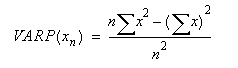
where x is the value and n is the number of values.
This function assumes that its arguments are the entire population. If your data represents only a sample of the population, then compute the variance using the [VAR](/document-solutions/dot-net-excel-api/docs/online/formula-reference/compatibility-functions/var) function.
This function differs from VARPA, which accepts logical or text values as well as numeric values.
## Examples
`VARP(B3,C4,B2,D10,E5)`
`VARP(A1:A9) VARP(R1C2,100,R2C5,102)`
`VARP(98,85,76,87,92,89,90)` gives the result 39.2653061224