# Creating Numeric Menu

## Content

The [C1RadialMenu](/componentone/api/wpf/online-basiclibrary/dotnet-framework-api/C1.WPF.4.6.2/C1.WPF.C1RadialMenu.html) control allows you to create a radial numeric slider menu. This is especially useful for applications where you might want users to select a font size for an application. You'll use both XAML markup and code to create the application.

Complete the following steps:

1. Locate the **\<Grid> \</Grid>** tags on your page and replace them with the following markup to create the framework for your application:

 ```xml
 <Page.Resources>
         <Style TargetType="TextBlock" x:Key="TextIconStyle">
             <Setter Property="Margin" Value="-10" />
             <Setter Property="FontSize" Value="20" />
             <Setter Property="FontFamily" Value="Segoe UI Symbol" />
             <Setter Property="FontWeight" Value="Normal" />
             <Setter Property="Foreground" Value="#333333" />
             <Setter Property="HorizontalAlignment" Value="Center" />
             <Setter Property="VerticalAlignment" Value="Center" />
         </Style>
         <Style TargetType="Image" x:Key="MenuIcon">
             <Setter Property="Width" Value="16"/>
             <Setter Property="Height" Value="16"/>
             <Setter Property="Margin" Value="0"/>
         </Style>
     </Page.Resources>
     <Grid Background="{ThemeResource ApplicationPageBackgroundThemeBrush}">
         <Xaml:C1ContextMenuService.ContextMenu>
         </Xaml:C1ContextMenuService.ContextMenu>
         <Xaml:C1ListViewer x:Name="text" Foreground="Sienna" HorizontalAlignment="Stretch" VerticalAlignment="Center" Height="75" ZoomMode="Disabled" FontSize="16" Xaml:C1NagScreen.Nag="True">
             <TextBlock Text="Touch: hold down for a few seconds until the indicator displays.&#10;Keyboard: press the context-menu button over this text.&#10;Mouse: right-click over this text." TextWrapping="Wrap" />
         </Xaml:C1ListViewer>
         <TextBlock x:Name="txt" Foreground="Red" Text="" FontSize="16" VerticalAlignment="Bottom" HorizontalAlignment="Center" Margin="10" />
 ```

2. Locate the **\<Xaml:C1ContextMenuService.ContextMenu></Xaml:C1ContextMenuService.ContextMenu>** tags within the markup you just added. Place your cursor between the tags.
3. Locate the **C1RadialMenu** control in the Visual Studio ToolBox and double-click it to add it to your application.
4. Edit the opening **\<C1RadialMenu>** tag so that it resembles the following:

 ```xml
 <Xaml:C1RadialMenu x:Name="contextMenu" Offset="-130,0" Opened="contextMenu_Opened" AccentBrush="ForestGreen" ItemClick="contextMenu_ItemClick" ItemOpened="contextMenu_ItemOpened" BorderBrush="#FFC6DEC4">
 ```

5. Add the following markup between the **\<C1RadialMenu> \</C1RadialMenu>** tags to add one **C1RadialNumericItems** to your application. Note that you are also adding several sub items and a custom item icon:

 ```xml
 <Xaml:C1RadialNumericItem Header="Font Size" Minimum="9" Maximum="72" MarkStartAngle="-128" MarkEndAngle="231" x:Name="fontSize" Value="11">
     <Xaml:C1RadialNumericItem.Icon>
       <TextBlock Style="{StaticResource TextIconStyle}" FontFamily="Segoe UI" FontSize="18">
          <Run Text="A"/>
          <Run Text="{Binding Value, ElementName=fontSize}" Typography.Variants="Superscript"/>
       </TextBlock>
    </Xaml:C1RadialNumericItem.Icon>
    <x:Double>9</x:Double>
    <x:Double>11</x:Double>
    <x:Double>13</x:Double>
    <x:Double>16</x:Double>
    <x:Double>20</x:Double>
    <x:Double>36</x:Double>
    <x:Double>72</x:Double>
 </Xaml:C1RadialNumericItem>
 ```

6. Right-click the page and select View Code from the list.
7. Add the following using statement to the top of the page:

 ```csharp
 using C1.WPF;
 OR
 using C1.Silverlight
 ```

8. Add the following **ItemClick** event to the page. This will allow the size of the text in the **TextBox** control to change size depending on the item selected:

 ```xml
 private void contextMenu_ItemClick(object sender, SourcedEventArgs e)
         {
             C1RadialMenuItem item = e.Source as C1RadialMenuItem;
 if (item is C1RadialNumericItem)
             {
                 txt.FontSize = ((C1RadialNumericItem)item).Value;
                 txt.Text = "Item Clicked: " + ((C1RadialNumericItem)item).Value.ToString();
             }
             else
             {
                 txt.Text = "Item Clicked: " + (item.Header ?? item.Name).ToString();
             }
         }
 ```

9. Then, add two more events. This code will control the **ItemOpened** and **Opened** events:

 ```xml
 private void contextMenu_ItemOpened(object sender, SourcedEventArgs e)
         {
             C1RadialMenuItem item = e.Source as C1RadialMenuItem;
             txt.Text = "Item Opened: " + (item.Header ?? item.Name).ToString();
         }
         private void contextMenu_Opened(object sender, EventArgs e)
         {
             // expand menu immediately, as in this sample we don't have    underlying editable controls
             contextMenu.Expand();
         }
 ```

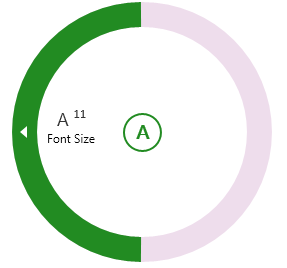
10. Press **F5** or start debugging to run your application. Your **C1RadialMenu** control should resemble the following:
 ![](https://cdn.mescius.io/document-site-files/images/7e9deccd-1f1c-4ec7-af90-b4332b45dead/images/radialmenu/numericmenu1.png)

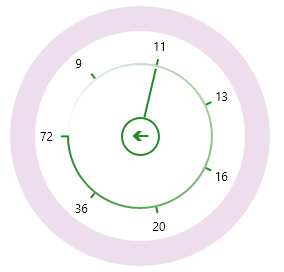
11. When you click on the **Font Size** option, the **C1NumericRadialItems** will be displayed:
 ![](https://cdn.mescius.io/document-site-files/images/7e9deccd-1f1c-4ec7-af90-b4332b45dead/images/radialmenu/numericmenu2.png)